There’s a moment many high-achieving women quietly arrive at.
Where the routines are in place and the habits are built.
But your body still feels… on edge.
Your mind races at night.
Your patience wears thin in moments that shouldn’t feel so heavy.
Rest doesn’t restore you the way it used to.
Nervous system regulation isn’t built through more pressure or intellectual understanding…
but felt safety in the body.
Through quiet, consistent moments where you show yourself that you are allowed to soften.
Not drastic life overhauls. Subtle, sensory rituals that gently bring your system back into balance.
Here are 6 to start with:
Turn Your Skincare Routine Into a Nervous System Ritual
Instead of moving through your skincare on autopilot, let it become a moment of presence.
Slow your touch and feel the temperature of the water, the texture of the cleanser, the silkiness of the moisturizer.
Gentle, repetitive touch activates C-tactile afferent nerve fibers, which are directly associated with emotional regulation and feelings of safety. This kind of stimulation signals your brain to increase parasympathetic nervous system activity. the state where your body can finally rest, digest, and repair.
Over time, this also helps to lower cortisol levels while increasing the hormone tied to calm, connection, and trust.
What was once a rushed routine becomes a quiet signal to your body.
Intentional Nail Days as a Grounding Practice
There’s something deeply regulating about tending to the smallest details of your body.
Focusing on precision, not perfection.
The fine motor activities needed to practice nail care engage the sensorimotor cortex, anchoring your awareness in the present moment. This reduces activity in the default mode network, the part of the brain responsible for overthinking and rumination.
The repetitive, detail-oriented nature of doing your nails also creates a mild meditative state, gently calming your nervous system.
And when you step back and see the beauty that you have created, the visual reward offers a soft release of dopamine. From simply presence.
If you want to learn how to do your own nails at home, I have a detailed tutorial here!
Warm Showers as a Full-Body Reset
Showers are therapeutic. I personally love being in any large body of warm water. Warm water stimulates thermoreceptors in the skin, sending signals directly to the brain that promote relaxation and calm. This process improves vagal tone, supporting the function of the vagus nerve which happens to be one of the body’s most important regulators of stress.
As your body warms and then gradually cools, it mirrors the natural rhythm that prepares you for rest. This is why evening showers can gently support deeper, more restorative sleep.
Water pulls you back into your body.
Into sensation.
Scent as a “Safety Anchor”
Scent is one of the fastest ways to shift your emotional state because it bypasses logic entirely.
Your sense of smell connects directly to the limbic system, the part of your brain responsible for memory and emotion.
When you intentionally pair a specific scent like an oil, a perfume or a body butter with moments of calm and slowness, your brain begins to associate that scent with safety.
Over time, this becomes a form of classical conditioning in the most embodied way.
Soft Textures and Sensory Regulation
The way your environment feels matters.
Soft fabrics against your skin like silk, cotton, or anything that feels gentle stimulate mechanoreceptors, which send calming signals to your brain. This kind of sensory input helps reduce sympathetic nervous system activation AKA your fight-or-flight response.
It’s the same principle behind why weighted blankets or soft textures feel comforting.
When your body is surrounded by softness, it receives continuous cues of safety without effort, without thought.
Drinking Something Warm, Slowly
Not on the go.
Just… slowly.
Holding a warm cup activates thermoreceptors in your hands, subtly signaling comfort and ease to your nervous system. Research even shows that physical warmth can influence emotional perception, making you feel more grounded and at ease.
And when you sip slowly, your breath naturally begins to lengthen especially the exhale.
This supports the activation of the vagus nerve, gently guiding your body out of stress mode.
So simple yet neurologically powerful.
A quiet reminder that you are not in danger.
Regulation Can Be Soft
For so long, you may have believed that feeling better required more effort.
But your nervous system doesn’t respond to force.
It responds to consistency, sensation, and safety.
These rituals won’t overhaul your life overnight and they aren’t supposed to.
They rewire your relationship with your body.
They teach it, slowly and steadily, that it no longer has to stay on edge.
And over time calm stops being something you chase and becomes something you live inside of.
If you are looking for more nervous system regulation practices, I go into great detail in my book!
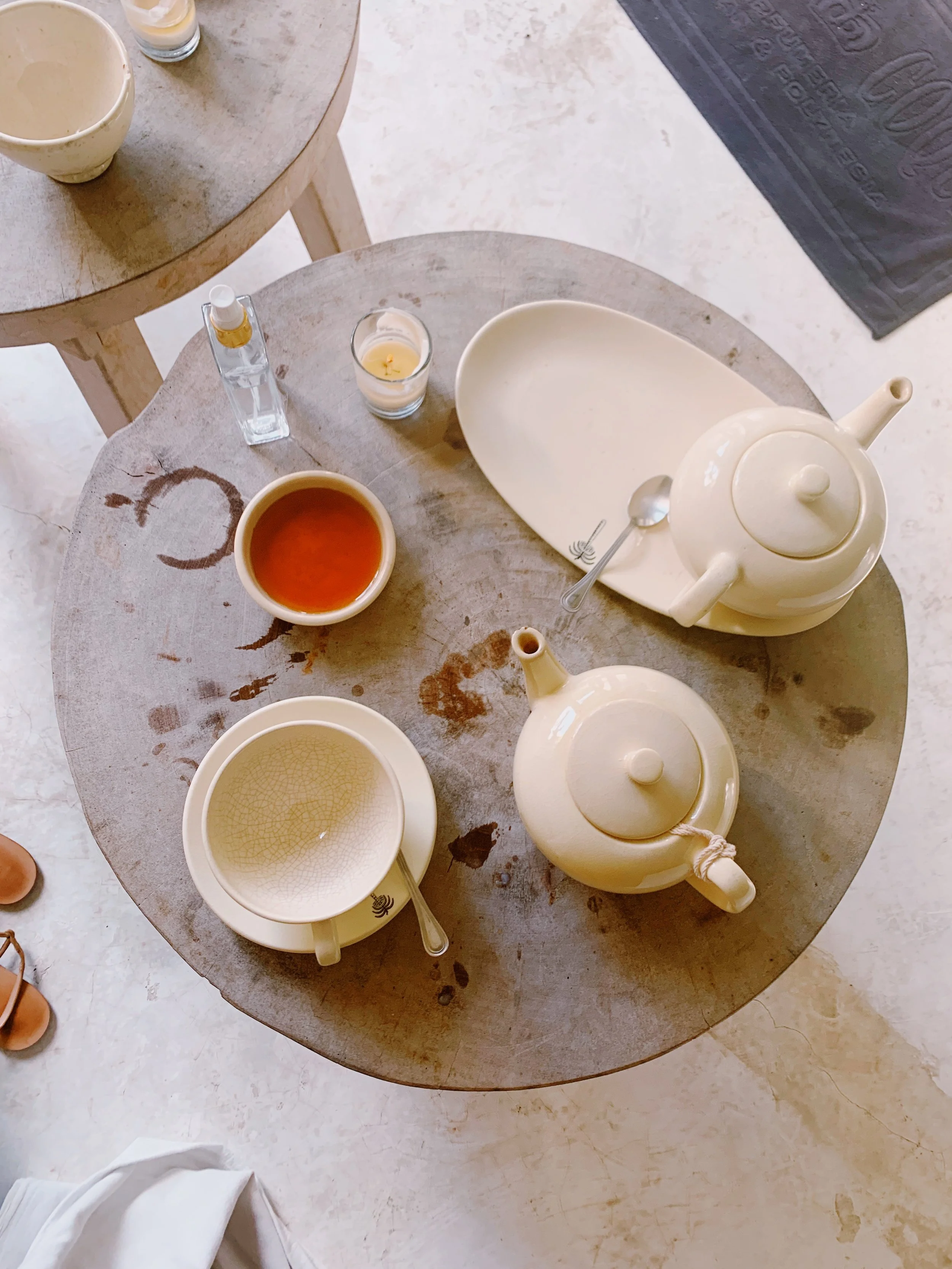
tea in Tulum
References
Mei Y, Zhou BL, Zhong D, Zheng XJ, Deng YT, Yu L, Jiang BC. From sensation to regulation: the diverse functions of peripheral sensory nervous system. Front Immunol. 2025 May 16;16:1575917. doi: 10.3389/fimmu.2025.1575917. PMID: 40453085; PMCID: PMC12123694.
Spille, J.L., Mueller, S.M., Martin, S. et al.Cognitive and emotional regulation processes of spontaneous facial self-touch are activated in the first milliseconds of touch: Replication of previous EEG findings and further insights. Cogn Affect Behav Neurosci 22, 984–1000 (2022). https://doi.org/10.3758/s13415-022-00983-4
Xie J, Elsadek M, Deshun Z, Zhou Z, Gao J. Tactile and olfactory stimulation reduce anxiety and enhance autonomic balance: a multisensory approach for healthcare settings. BMC Psychol. 2025 Jul 18;13(1):806. doi: 10.1186/s40359-025-03140-x. PMID: 40682204; PMCID: PMC12275342.